ShieldTech's Towing Glass Protection: What RV Owners Should Know
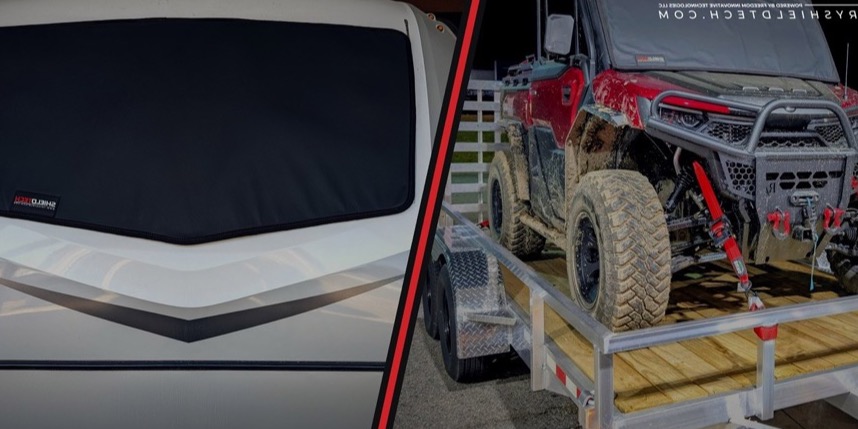
Before ShieldTech could sell anything, someone had to figure out how to build it. That someone was Freedom Innovative Technologies, ShieldTech’s parent company and its factory.
There was no manufacturer to call and no off-the-shelf equipment that could turn raw material goods into a windshield cover shaped to fit a specific RV or side-by-side.
The reason any of that engineering effort mattered traces back to a problem most RV and side-by-side owners eventually run into. Hours behind a semi on the highway, loose gravel on a forest service road, a trailer bouncing through a pothole, any of it can send a rock into a windshield that costs real time and real money to replace mid-trip. ShieldTech's cover was built to take that risk off the table before a trip ever starts.
"When we developed this, we went from contract manufacturing to in-house manufacturing in about 120 days of launching the product to the market," says Jason Jonas, CEO of ShieldTech. "Nobody on our team came from manufacturing. We had to build and hone in the whole process. Literally everything down to the smallest detail is specifically designed."
That process started small, with founder and inventor Keith Black solving his own problem after his side-by-side's glass was repeatedly damaged while he hauled it through the Rocky Mountains for work in the oil field. The fix that followed became a patent-pending magnetic protection system with no direct competitor offering an equivalent product in the RV and side-by-side category.
Getting from a working prototype to a repeatable manufacturing process meant customizing the sewing machines and designing processes from the ground up, building tools that did not exist yet for materials no standard equipment was built to handle.
The technology has already picked up outside recognition ahead of any formal marketing push, including a feature in Dirt Wheels Magazine, Off-Road.com and an appearance on the television program Motorhead Garage, both centered on the technology behind the concept of the product rather than the company’s growth story.
The payoff shows up in how the company operates today. What was once a small operation straining to keep up with demand is now a lean team that Jonas says outperforms a much larger one.
"We became lean because we sharpened the process, over and over," he says. "A small team performs way better than a big team, and that's where we're headed."
Every cover is still engineered for a specific fitment rather than built as a generic, one-size-fits-all product. That decision adds manufacturing complexity but is central to how the company thinks about the product working as intended in the field, not just in the shop.
Inside the company, the design does not stop evolving just because it already works. As Black says, the internal standard, good enough is not good enough, is why fitments and materials keep getting revisited even after a version has already shipped successfully to thousands of customers.
"It's the highest quality materials you can get for the outdoor space, the foam, the vinyl, even the thread," Jonas says. "It's the most durable, longest lasting product you can get."
The manufacturing platform ShieldTech built for RVs and side-by-sides has already proven flexible enough to go beyond its original scope. The company has taken on custom work protecting glass on boats, additional RV models and classic cars.
"We've done custom boats, custom RVs, old school classic cars," Jonas says. "Anything with glass can be protected. That's what we want to get to at some point. If you have glass, we protect it."
That flexibility matters as the company looks toward selling in heavy equipment and marine as its next product categories, verticals where the same windshield exposure problem exists while towing and, according to the company, no premium solution currently does.
It also matters to the corporations ShieldTech is now talking to. The possibility of large corporations considering SHieldTech for a factory-install program is not just about buying a product. It is a bet on whether Freedom Innovative Technologies can keep building that same quality at a larger volume, which is exactly the question the company's manufacturing story is built to answer.
The engineering story is also part of a longer-term positioning play. Jonas has pointed to WeatherTech as a reference point for what ShieldTech is trying to build, not a single hit product but a category, defined by a manufacturing standard that is hard to copy because it was never built to be copied quickly in the first place.
For now, the work stays close to home. Every cover is still built in the same Phoenix, Arizona facility where the company invented its process, tested what failed and rebuilt what did not work the first time.
The company is planning an eventual expansion of its manufacturing footprint toward Indiana, positioning itself closer to the center of the American RV industry as conversations with manufacturers progress. For an operation built by inventing its own tools the first time around, scaling that same discipline to a second facility is the next engineering problem to solve.
To learn more about ShieldTech's manufacturing process or explore its current product line, visit tryshieldtech.com.
NOTE: This is sponsored content produced in partnership with ShieldTech
Specs, pricing and availability can change by model year and dealer. Always confirm with the manufacturer and match the rig to your tow vehicle's ratings.